
Garage Floor Coating Omaha NE: Durable Epoxy and Polyaspartic Floors for Commercial Garages

| Point | Details |
|---|---|
| Best-fit systems | Epoxy and polyaspartic flake systems are common choices for garage floor coating Omaha NE projects because they add durability, cleanability, chemical resistance, and professional appearance in commercial settings. |
| Local conditions | Omaha commercial garages deal with freeze-thaw cycles, road salt, snow melt, hot tires, oil, fluids, and humidity swings that require proper concrete preparation. |
| Professional prep matters | Diamond grinding, crack repair, moisture awareness, and correct film build are what separate a long-lasting floor from a coating that peels early under vehicle and equipment traffic. |
| Epoxy vs. polyaspartic | Epoxy provides strong build and adhesion, while polyaspartic topcoats offer UV stability, faster return to service, and strong chemical resistance. |
| Finish quality | A well-installed flake floor should look uniform, feel controlled underfoot, and deliver a clean, high-quality surface with strong visual impact for staff, customers, and visitors. |
Why Commercial Garage Floor Coating Omaha NE Projects Need Professional Systems
If you are researching garage floor coating Omaha NE for a commercial garage, the goal is usually simple: turn a dusty, stained, cracked concrete slab into a clean, durable, professional floor that can handle daily operations. In Omaha, that floor has to stand up to more than parked vehicles. It needs to manage winter road salt, snow melt, service equipment, oil drips, fluid exposure, humidity, and seasonal temperature movement.
Uncoated concrete is porous. It absorbs liquids, sheds dust, stains easily, and can become harder to clean over time. A professional concrete floor coating Omaha NE system creates a sealed, wear-resistant surface that improves cleanability and helps protect the slab from common contaminants found in fleet garages, service bays, maintenance shops, dealership work areas, and commercial storage facilities.

For commercial property owners, facility managers, and operations teams, the upgrade is also about presentation and efficiency. A decorative flake or sealed resinous system can make a garage, service area, or vehicle bay feel cleaner, brighter, and more intentional. The same performance mindset used in commercial and industrial flooring applies to garage environments: surface prep, product selection, coverage rate, cure timing, and topcoat quality all matter.
Expert note: Most garage coating failures are not caused by the color or flake blend. They are caused by poor concrete preparation, moisture issues, thin film build, or incompatible products.
Organizations such as the American Concrete Institute publish concrete standards and technical resources that reinforce a core principle: concrete performance depends on preparation, conditions, and correct system design. That is why a commercial garage coating should be treated as a flooring system, not just a layer of paint.
Epoxy vs. Polyaspartic Garage Floor Coatings
Business owners and facility managers often search for garage floor epoxy Omaha because epoxy has become the common name for many garage coating systems. Epoxy is a proven resin technology that can provide excellent adhesion, build thickness, impact resistance, and a strong base for decorative flake broadcast. It is especially useful when a project needs body, working time, and a robust foundation over properly prepared concrete.
A polyaspartic garage floor coating Omaha system is another strong option, often used as a fast-curing, UV-stable topcoat or as part of a full system. Polyaspartic coatings can return a commercial garage to service quickly, resist yellowing better than many standard epoxies, and provide a hard-wearing surface for tires, tools, carts, parts, and maintenance chemicals. The best specification depends on slab condition, use expectations, schedule, traffic level, and desired appearance.
| System Type | Strengths | Best Use | Considerations |
|---|---|---|---|
| Epoxy base coat | Strong adhesion, good build, excellent flake acceptance | Commercial garage floors needing a durable foundation and full flake broadcast | Longer cure window than fast polyaspartic systems |
| Polyaspartic topcoat | UV stability, fast cure, chemical resistance, high clarity | Protective finish coat over decorative flake floors in working garage environments | Requires skilled handling due to shorter working time |
| Full flake system | Decorative appearance, hides minor concrete variation, durable surface | Commercial garages, service bays, workshops, storage areas, and light industrial spaces | Surface texture and traction should be selected intentionally |
| Sealed concrete | Simple protection, lower visual build, easier refresh cycles | Basic dust control, utility areas, or back-of-house vehicle spaces | Not the same thickness or decorative impact as epoxy/polyaspartic flake |
Epoxy and polyaspartic products are both part of the broader family of resinous flooring. For background on epoxy chemistry, Wikipedia’s epoxy overview provides a general explanation of how epoxy resins are used in coatings, adhesives, and composite materials. In garage flooring, the chemistry matters, but installation quality is what determines whether the system performs under real use.
Pro Tip: Do not choose a commercial garage coating by cure speed alone. A one-day system can be excellent when the slab is properly prepared and conditions are right, but rushing over cracks, moisture, or contamination can shorten the life of the floor.
How Professional Garage Floor Coating Installation Works
A professional garage coating starts with inspection. The installer evaluates the age and condition of the slab, existing sealers, oil contamination, cracks, surface profile, moisture risk, drainage, and expected traffic. This step determines whether the project is a straightforward coating, a garage floor resurfacing Omaha project, or a more involved repair-and-coat system for a commercial garage or service facility.
Mechanical preparation is the key step. Diamond grinding opens the concrete surface and creates a profile that allows the coating to bond. Acid etching is often less controlled than grinding and may not remove existing coatings, curing compounds, or embedded contaminants effectively.

After grinding, the installer repairs cracks, divots, spalls, and control joint issues as needed. Then the base coat is applied at the proper coverage rate, decorative flake is broadcast, excess flake is removed after cure, and one or more clear topcoats are installed. The result should be a sealed, uniform surface with controlled texture and strong visual consistency.
- Inspection: Identify cracks, moisture concerns, oil, scaling, old coatings, and slab movement.
- Grinding: Mechanically profile the concrete for coating adhesion.
- Repair: Fill cracks, pits, and surface defects before coating.
- Base coat: Install epoxy or polyaspartic base at the correct film thickness.
- Flake broadcast: Apply decorative vinyl flake to rejection or selected coverage level.
- Topcoat: Lock in the system with a durable clear coat designed for wear and cleanability.
For commercial teams comparing coating options, the difference is usually in preparation equipment, material solids content, repair discipline, topcoat performance, and the ability to plan around operational downtime. A professionally installed coating is specified as a system and installed with tools and timing that support long-term adhesion in demanding garage environments.
For related surface options beyond commercial garages, Custom Concrete Creations also works with Epoxy, Flooring Removal 101 What Happens Before Your New Concrete Finish, and Why Polished Concrete Is Becoming The Go To Flooring Choice For Modern Commercial Spaces for commercial and industrial spaces throughout the Omaha area.
Design, Performance, and Maintenance Considerations
A garage floor coating is not only a protective layer. It changes how the space functions and presents to employees, customers, vendors, and inspectors. Flake size, color blend, gloss level, and topcoat clarity all influence the finished look. A high-quality clear coat can improve depth, clean reflection, and overall finish quality, while a poorly applied coating can look cloudy, uneven, or thin.
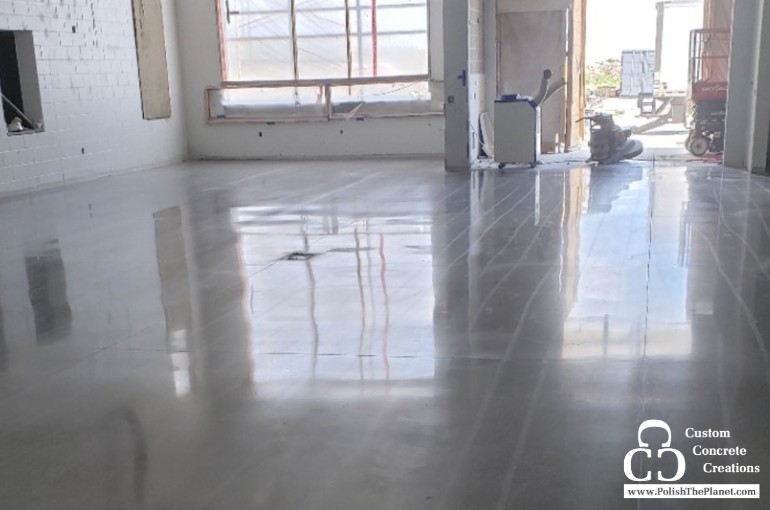
In commercial flooring, finish evaluation often includes ideas such as clarity, reflectivity, and DOI, or distinctness of image. While a garage flake floor is not polished concrete and should not be described as polished concrete, the same attention to finish quality matters. Clean edges, even broadcast, consistent texture, and a well-cured topcoat produce a surface that looks intentional instead of improvised.
Maintenance is straightforward when the coating is installed correctly. Sweep grit regularly, rinse salt residue during winter, clean spills promptly, and avoid dragging sharp metal edges across the floor. The Occupational Safety and Health Administration highlights slips, trips, and falls as a major safety concern in workplaces, and that same logic applies directly to commercial garage environments: traction, housekeeping, and surface condition all affect safety.
| Maintenance Task | Recommended Frequency | Why It Matters |
|---|---|---|
| Sweep or dust mop | Daily, weekly, or as needed based on traffic | Removes grit that can abrade the topcoat over time |
| Rinse winter salt | During snow season | Reduces residue buildup and chemical exposure |
| Clean oil or chemical spills | Promptly | Protects appearance and reduces slip risk |
| Use soft pads under heavy equipment | As needed | Helps prevent gouges from concentrated sharp loads |
| Inspect high-traffic areas | Seasonally or as part of facility maintenance | Allows early attention to wear before it becomes a larger issue |
Indoor air quality and odor are also part of the planning conversation, especially for occupied commercial buildings or garages connected to active work areas. Some coating products contain volatile organic compounds, and ventilation matters during installation. The U.S. Environmental Protection Agency provides general information on VOCs and indoor air quality, which is useful for facility teams that want to understand coating odors and ventilation needs.
For organizations considering a broader facility improvement plan, commercial garage coatings can pair well with Difference Between Polished And Sealed Concrete Floors, Polished Concrete, or decorative concrete upgrades in showrooms, warehouses, service corridors, production areas, or utility spaces. The right system depends on the space, the concrete, the desired look, and how the floor will be used.
Choosing a Garage Floor Coating Contractor in Omaha
Choosing a contractor for Omaha garage floor sealing or a full decorative flake system should come down to process, not just price. Ask how the concrete will be prepared, what products will be used, how cracks will be handled, what cure time is expected, and what maintenance the floor will require. A credible installer should be able to explain the system clearly without overselling it.
Local experience matters because Omaha commercial garages see harsh seasonal conditions. Freeze-thaw cycles, deicing salts, and moisture tracked in from vehicles create a demanding environment. A coating that works in a dry storage room may not be appropriate for a working garage that sees wet tires, hot tires, tools, carts, lifts, and chemical exposure.
Contractor checklist: Look for mechanical surface prep, clear system specifications, realistic return-to-service guidance, crack repair planning, and finish samples that show actual texture and gloss.
Custom Concrete Creations approaches commercial garage floors with the same system-first mindset used on commercial and industrial projects. That means focusing on substrate preparation, coating compatibility, finish uniformity, clean edges, and long-term value. The objective is not just to cover concrete; it is to create a floor that performs and looks professionally finished.
Facility managers, property owners, and business operators who want a tailored recommendation can schedule a consultation for garage floor epoxy Omaha projects, polyaspartic systems, decorative flake floors, sealed concrete, or broader concrete flooring upgrades. A project review helps determine whether your slab needs coating, resurfacing, sealing, crack repair, or another finish path.

Transform your concrete with a professional finish
Request a custom flooring recommendation or quote for commercial or industrial concrete flooring projects in the Omaha area.
Frequently Asked Questions
What is the best garage floor coating for Omaha commercial garages?
The best garage floor coating for Omaha commercial garages is usually a professionally installed epoxy or polyaspartic flake system. These systems handle road salt, hot tires, oil, moisture, vehicle traffic, and daily wear better than thin coatings when the concrete is properly prepared.
Is polyaspartic better than epoxy for a garage floor?
Polyaspartic is often better for UV stability, fast cure time, and topcoat durability, while epoxy is excellent as a high-build base coat with strong adhesion. Many premium systems use both technologies together rather than treating them as an either-or choice.
How long does a garage floor coating last in Omaha NE?
A professionally installed garage floor coating can last many years when the slab is prepared correctly and the floor is maintained properly. Longevity depends on concrete condition, moisture, film thickness, traffic, chemical exposure, and the quality of the coating system.
Can a cracked garage floor be coated?
Yes, many cracked garage floors can be coated after proper crack repair and surface preparation. However, active structural movement or severe slab deterioration may require additional evaluation before a coating system is recommended.
How soon can I use my garage after epoxy or polyaspartic coating?
Return-to-service time depends on the coating system, temperature, humidity, and product cure schedule. Some polyaspartic systems allow faster use, but the installer should provide specific guidance for foot traffic, storage items, equipment, and vehicle traffic.
A Better Commercial Garage Starts with the Right Flooring System
A quality garage floor coating is a practical upgrade with a visible payoff. It improves cleanability, reduces concrete dust, resists common garage contaminants, and gives the space a finished appearance that holds up to real commercial use.
For Omaha businesses and facilities, the best results come from matching the system to the slab and installing it with discipline. Whether the right answer is garage floor epoxy Omaha, a polyaspartic garage floor coating Omaha system, garage floor resurfacing Omaha, or Omaha garage floor sealing, the details determine the outcome.
Transform your concrete with a professional finish