
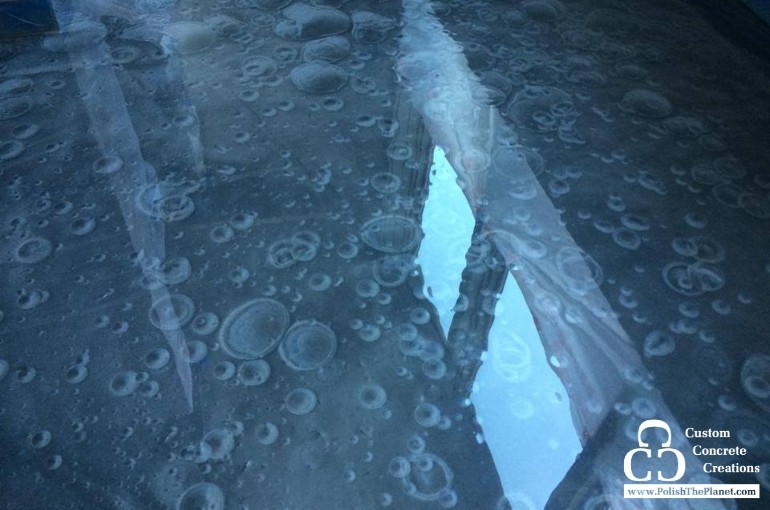
If you have ever seen an epoxy floor mid-installation, you may have noticed circular patterns or bubble-like formations across the surface. For property owners, that moment can raise concern. Is the floor failing before it is even finished?
In most cases, what you are seeing is a normal part of the epoxy installation and curing process. The key difference between a temporary condition and a long-term issue comes down to preparation, timing, and application technique.
The Science Behind the Bubbles
Concrete is not solid in the way most people think. It is porous and contains microscopic air pockets throughout the slab. When epoxy is applied, especially in thicker coats, it seals the surface quickly. As the coating begins to level, trapped air inside the concrete can rise upward.
This process is called outgassing.
As air escapes from the slab, it creates visible bubbles in the wet epoxy. These circular formations are often temporary and can be released using specialized tools during installation.
Professional installers use spiked rollers to help break surface tension and allow trapped air to escape before the epoxy begins to harden. When handled properly, the coating settles into a smooth, seamless finish.
Why Surface Preparation Is Everything
Outgassing becomes a problem only when preparation is inadequate.
Before epoxy is installed, the slab must be mechanically ground to open the surface. This removes contaminants, old coatings, and weak surface material while creating a proper profile for bonding.
Moisture testing is equally important. Excess moisture vapor transmission can force air and vapor through the coating, leading to adhesion problems or long-term failure.
A properly prepared slab significantly reduces the risk of permanent bubbling or coating defects.
Environmental Conditions Matter
Temperature and humidity directly impact epoxy performance.
If epoxy is applied while slab temperatures are rising, air inside the concrete expands and pushes upward more aggressively. This increases the chance of visible air release. Experienced installers monitor both ambient and slab temperatures to ensure conditions are stable before application.
Working within the correct temperature window allows the epoxy to level properly without excessive air movement.
From Installation to Finished Floor
The wet stage of epoxy installation does not represent the final result. Epoxy is a self-leveling system designed to settle and cure into a dense, durable coating.
Once cured, a properly installed epoxy floor provides:
Chemical resistance
Impact resistance
Moisture protection
Seamless cleaning surfaces
Long-term durability
The difference between a professional system and a failed coating is rarely the product itself. It is the preparation and process behind it.
The Bottom Line
Seeing bubbles during epoxy installation does not automatically mean something is wrong. In many cases, it is a temporary stage of air release from the concrete substrate.
What truly determines performance is proper grinding, moisture control, environmental timing, and skilled application.
When installed correctly, epoxy flooring delivers strength, protection, and a clean finish built to perform for years.