
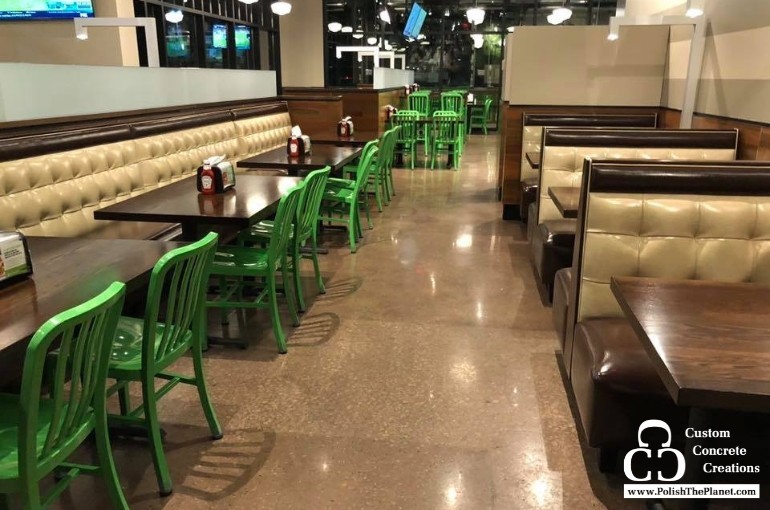
Restaurants demand more from their floors than almost any other commercial space. Heavy foot traffic, constant chair movement, food spills, cleaning chemicals, and long operating hours all test a surface daily. The floor has to perform without distracting from the atmosphere. That is where polished concrete stands apart.
In modern dining environments, polished concrete delivers durability, sanitation, and design flexibility in one seamless system.
Built for Constant Traffic
Dining rooms experience nonstop movement. Guests, servers, bussers, and equipment are in motion from open to close. Traditional flooring systems like tile, vinyl, or coatings often show wear patterns, chipped edges, or failing seams over time.
Polished concrete is mechanically refined and densified, strengthening the slab from within. There are no grout lines to crack and no layers to peel. The surface holds up under chairs sliding, tables shifting, and thousands of footsteps each week. For restaurant owners, that means fewer repairs and less downtime.
Easier Cleaning and Better Sanitation
Cleanliness is not optional in food service. Spills happen constantly, from drinks to sauces to grease. Porous flooring absorbs contaminants and becomes harder to maintain over time.
Polished concrete tightens the surface of the slab, reducing porosity and helping prevent liquids from penetrating. Spills stay on top longer, allowing staff to clean them quickly and efficiently. Daily maintenance typically involves dust mopping and routine scrubbing, without waxing or complicated recoating cycles.
The seamless nature of polished concrete also eliminates grout joints where bacteria and debris can collect, supporting a cleaner environment overall.
Lighting That Works Harder
Restaurants rely heavily on lighting to create ambiance. Polished concrete enhances that effort. Its reflective surface bounces light throughout the space, brightening dining areas and reducing harsh shadows.
This reflectivity can also contribute to improved energy efficiency. When light is amplified by the floor, fewer fixtures may be needed to achieve the desired effect. The result is a dining space that feels open, clean, and inviting.
Aesthetic Flexibility
Polished concrete is not limited to one look. It can range from matte and subtle to high-gloss and dramatic. Aggregate exposure can add visual texture, while stains or dyes introduce warmth and tone.
In a space like this, the floor complements wood tables, upholstered booths, and vibrant seating without competing for attention. It acts as a refined foundation that supports the overall design.
Long-Term Value
Replacing restaurant flooring is disruptive and expensive. Polished concrete offers long-term performance with minimal lifecycle costs. There is no waxing, no stripping, and no frequent replacement.
For restaurant owners focused on operational efficiency, durability, and design, polished concrete is more than a trend. It is a strategic investment.